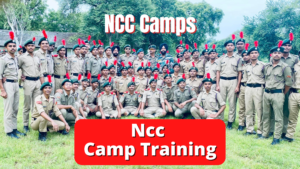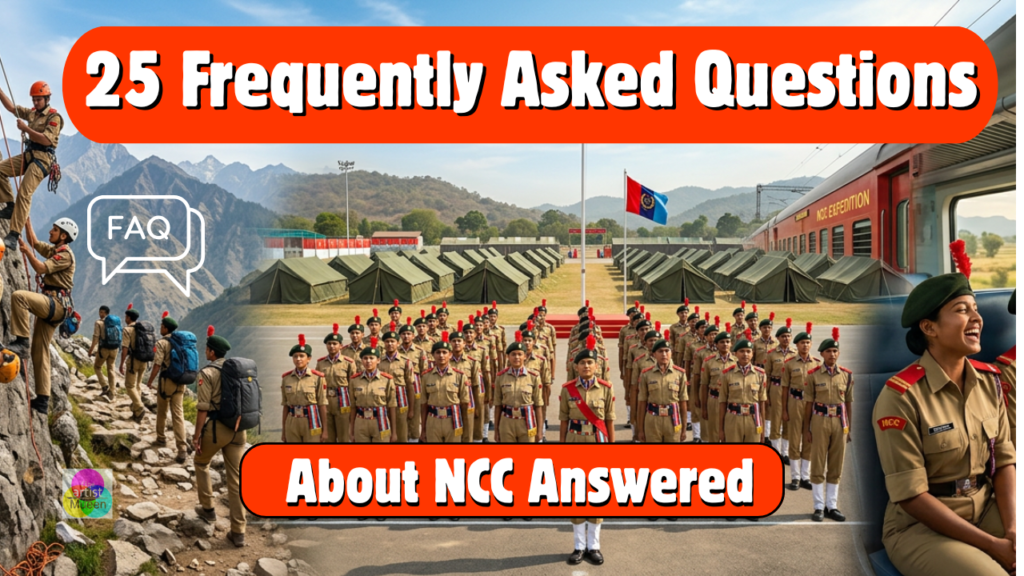
Every year, thousands of school and college students in India consider joining the ‘National Cadet Corps (NCC)’. But most of them have the same doubts. What is NCC exactly? Is it worth joining? Does it help with jobs or admissions?
Actually, NCC blends discipline, patriotism, and career benefits; it naturally raises a lot of curiosity among students and parents alike. This blog answers the 25 most frequently asked questions about NCC in a simple, easy-to-understand way, so you can decide if it’s the right path for you.
25 FAQs About NCC
1. What is NCC, and what does it stand for?
NCC stands for ‘National Cadet Corps’, a youth organization in India that provides military training to school and college students. It aims to develop character, discipline, and leadership among young citizens.
2. When was NCC established, and what is its motto?
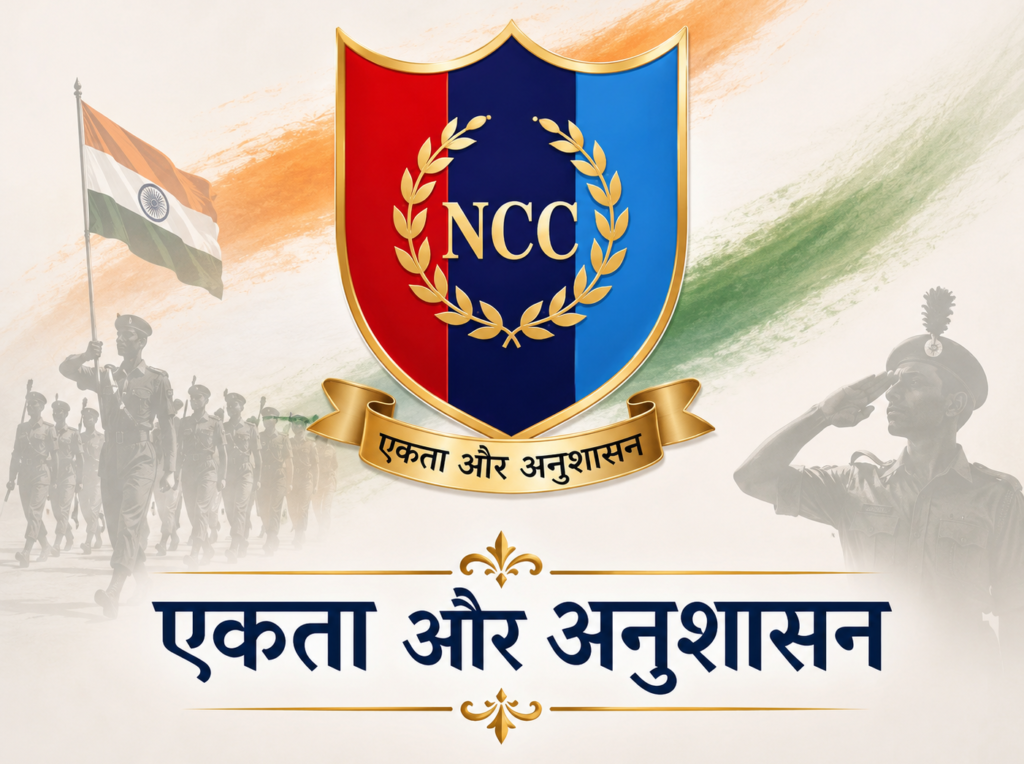
NCC was established in 1948 under the NCC Act. Its motto is “Unity and Discipline.”
3. Who can join NCC, and what is the age criterion?
Students aged 13 to 26 years, studying in recognized schools and colleges, can join NCC. Both boys and girls are eligible.
4. What are the different divisions in NCC?
NCC has two main divisions: the Junior Division/Wing for school students and the Senior Division/Wing for college students.
5. What are the wings of NCC?
NCC has three wings — Army, Navy, and Air Force — allowing cadets to choose training based on their interests.
6. How can I enroll in NCC?
You can enroll through your school or college by contacting the NCC officer or filling out an enrollment form, usually at the start of the academic year.
7. Is NCC compulsory or voluntary?
NCC is completely voluntary. Students choose to join based on personal interest.
8. What are the benefits of joining NCC?
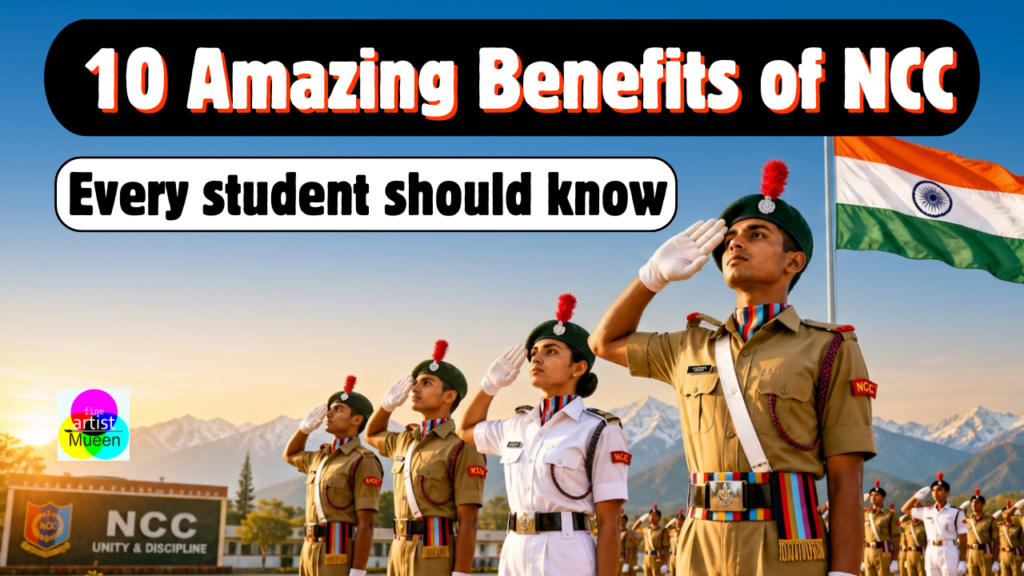
NCC builds discipline, leadership, confidence, and physical fitness. It also offers career advantages, adventure opportunities, and a chance to serve the nation.
9. What certificates does NCC offer?
NCC offers three certificates — ‘A’ Certificate (Junior Division), ‘B’ Certificate, and ‘C’ Certificate (Senior Division), each awarded after specific training years and exams.
10. How do NCC certificates help in careers?
NCC certificates provide bonus marks in defence exams, priority in military recruitment, and added weightage in some government job applications and college admissions.
11. What is the NCC song and flag?
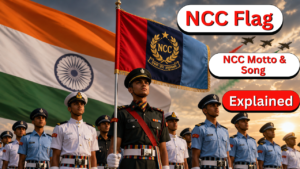
The NCC song reflects the spirit of unity and service, while the NCC flag features three colours — Red, Dark Blue, and Sky Blue — symbolizing the Army, Navy, and Air Force wings.
12. What activities are conducted in NCC?
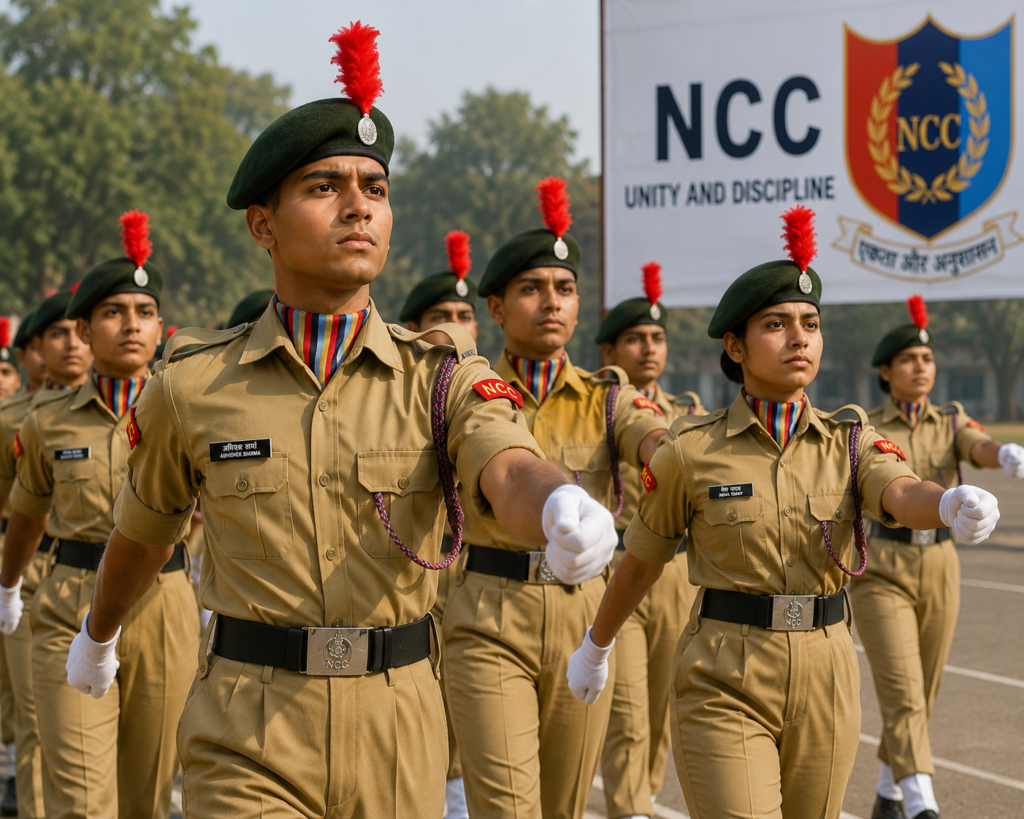
Cadets participate in drills, parades, shooting practice, adventure camps, trekking, social service, and disaster relief training.
13. What is the Republic Day Camp (RDC)?
Republic Day Camp (RDC) is a prestigious annual camp where selected cadets from across India participate in the Republic Day Parade in New Delhi, showcasing their skills before the nation.
14. Does NCC guarantee a job in the Armed Forces?
No, NCC does not guarantee a job, but it gives cadets an edge during defence recruitment through relaxed criteria and bonus marks.
15. Can girls join NCC?
Yes, girls are actively encouraged to join NCC and participate in all its activities, including camps and adventure programs.
16. What is the NCC uniform?
The uniform varies by wing but generally includes olive green (Army), white (Navy), or light blue (Air Force) attire along with badges, belts, and berets.
17. Is there any fee to join NCC?
NCC training is largely free, although minor charges may apply for uniforms or participation in camps in some institutions.
18. What is the duration of NCC training?
Junior Division training lasts 2 years, while Senior Division training extends up to 3 years, including annual camps and parades.
19. Can NCC cadets carry weapons?
Yes, cadets receive basic weapon training (like rifles) for educational and ceremonial purposes under strict supervision, without live ammunition in most cases.
20. What is the role of NCC during emergencies?
NCC cadets assist during natural disasters, national emergencies, and social causes, including relief work and awareness campaigns.
21. When is NCC Day celebrated?
NCC Day is celebrated on the fourth Sunday of November every year with parades and events across India.
22. How does NCC help in personality development?
NCC develops leadership, teamwork, time management, and communication skills in students. It also helps students to grow confidently.
23. Can ‘C’ certificate holders get direct entry into the Army?
Yes, NCC ‘C’ certificate holders with good grades can get direct entry into the Indian Army through special NCC entry schemes, bypassing certain exams.
24. What is the difference between NCC and NSS?
NCC focuses on military training and discipline, while NSS (National Service Scheme) focuses on community service and social work.
25. How can I prepare for NCC selection?
Maintain good academic records, stay physically fit, and show enthusiasm during interviews or selection camps conducted by your institution.
Conclusion
NCC is much more than a uniform and a parade. It is a platform that shapes disciplined, confident, and patriotic citizens. From leadership skills to career advantages in defence and government sectors, the benefits of joining NCC are immense. If you’re a student & looking to build character while serving your nation, NCC is a fantastic choice.
Found this blog helpful? Share it with your friends, drop your own NCC-related questions in the comments, and explore more content on our blog to guide your NCC journey! Thanks for visiting this blog.